
Woman, 23, Says Symptoms Were Dismissed Before Severe Full-Body Rash Appeared

For years, Lily Thompstone lived with constant discomfort that she struggled to explain. Doctors offered reassurance, but she says her concerns were repeatedly brushed aside.

At 23, her body eventually responded in a way she could no longer ignore. What began as gut problems escalated into a severe rash that spread across most of her body, forcing her to keep searching for answers.

Her experience has since resonated with others who say they, too, felt unheard before their symptoms worsened.

Living with ongoing discomfort

Thompstone, from Greater Manchester in England, says she had always dealt with digestive issues. Eating often made her feel unwell, and discomfort became part of her daily routine.

She was initially told she had irritable bowel syndrome. While IBS can be painful and disruptive, she felt the explanation didn’t fully account for how unwell she felt.

Despite repeated appointments, she says her symptoms were treated as manageable rather than concerning.

Lily Thompstone woke up with swollen lips.
Lily Thompstone woke up with swollen lips (Kennedy News and Media)
A sudden and frightening change

In May 2023, her health took a dramatic turn. She woke up one morning with severe swelling in her lips, which led to an urgent hospital visit.

Doctors initially suspected an allergic reaction and treated her with steroids. The swelling reduced, but Thompstone says the episode reinforced her belief that something deeper was wrong.

She recalls feeling alarmed, yet still unsure how to convince doctors that her symptoms were connected.

New symptoms, familiar frustration

About a month later, a rash appeared on her chest. Concerned, she visited multiple doctors hoping for clarity.

She was told it could be related to light sensitivity or psoriasis. While those explanations offered some direction, she says they still didn’t address the bigger picture.

Over time, the rash worsened rather than improved.

When the rash spread

The condition progressed quickly. Thompstone developed a scaly rash that eventually covered an estimated 80 to 90 percent of her body.

Showering became painful. Even small movements caused discomfort as her skin reacted.

She describes the experience as overwhelming, both physically and emotionally, and says it affected her confidence and willingness to be seen in public.

She a developed a 'scaly' rash that spread all over her body.
She a developed a ‘scaly’ rash that spread all over her body (Kennedy News and Media)
Coping while searching for answers

In an effort to calm her symptoms, she tried UVB light therapy and salt baths. These measures helped slightly, but did not resolve the underlying issue.

She also began sharing photos of her condition online. Alongside the images, she posted a message urging others to pay attention to prolonged stress and unresolved symptoms.

For her, the rash felt like a visible signal that her body was under strain.
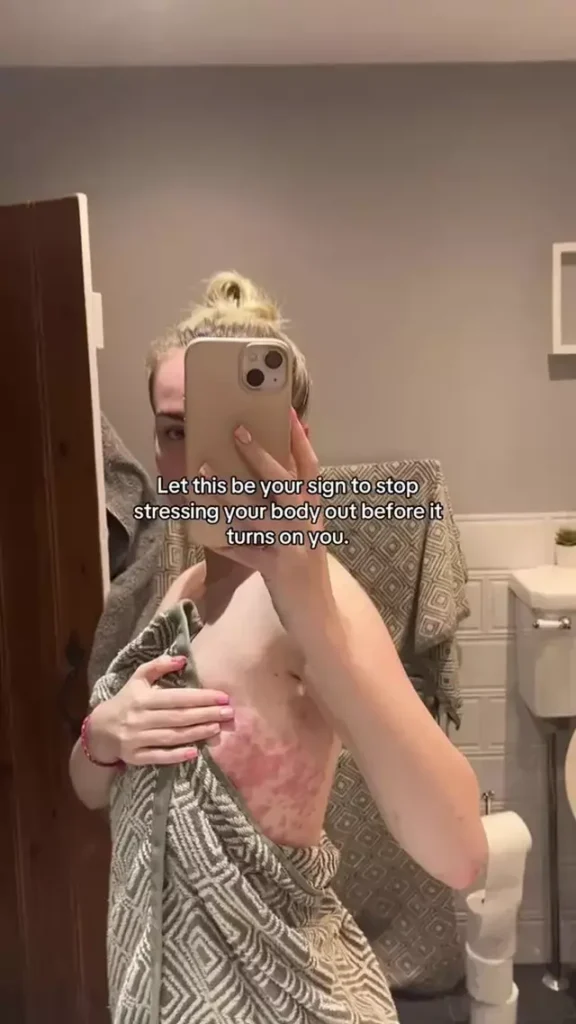
The content creator shared images of her rash online with a warning to others.
The content creator shared images of her rash online with a warning to others (Kennedy News and Media)
A diagnosis after going private

After nearly a year without clear answers, Thompstone decided to seek private medical care. It was there that she was diagnosed with endometriosis.

Endometriosis is a condition where tissue similar to the lining of the womb grows elsewhere in the body. According to the NHS, it can cause chronic pain and digestive symptoms, and it is often difficult to diagnose.

Specialists reportedly found extensive signs of the condition, which Thompstone says explained years of pain that had previously been attributed to IBS.

Reflecting on the impact

Since her diagnosis, she has undergone two surgeries, the most recent in late 2025. While recovery has been challenging, she says finally having answers has been validating.

Looking back, Thompstone believes prolonged physical stress and the absence of a diagnosis contributed to her skin condition. She describes her body as being under sustained pressure, both physically and emotionally.

Now, she is encouraging others, particularly women, to advocate for themselves if symptoms persist.

She now believes years of 'chronic physical stress' from a lack of diagnosis was the cause of her rash.
She now believes years of ‘chronic physical stress’ from a lack of diagnosis was the cause of her rash (Kennedy News and Media)
Why her story is resonating

Delayed diagnosis is a common issue in chronic conditions, especially those with overlapping symptoms. Thompstone’s experience highlights how physical illness, stress, and mental health can intersect.

Her message is not about assigning blame, but about persistence. She says feeling dismissed had a lasting impact, but continuing to seek help ultimately changed the course of her health.

For many readers, her story serves as a reminder that unresolved symptoms deserve attention, even when initial explanations seem reassuring.

Health Disclaimer
This article is for informational purposes only and is not intended as medical advice. Always consult a qualified healthcare professional before making any changes to your health, diet, or treatment.

Featured Image Credit: Kennedy News and Media

Concerns Raised After Elderly Woman Allegedly Euthanized Against Her Wishes

Assisted dying laws are designed to protect patient choice at the end of life. But a recent case in Canada is prompting renewed scrutiny after questions emerged over whether those safeguards were properly followed.

An elderly woman, referred to in official documents as Mrs B, was euthanized under Canada’s Medical Assistance in Dying program, despite reportedly expressing a desire to withdraw her request.

The case has now been reviewed by Ontario’s Medical Assistance in Dying Death Review Committee, with its findings raising serious concerns about consent, timing, and external pressures.

What MAiD allows in Canada

Medical Assistance in Dying, known as MAiD, is legal in Canada when strict legal and medical criteria are met. Patients must be capable of making the decision independently and must provide informed consent without coercion.

Eligibility also requires a serious and incurable illness, advanced decline, and enduring suffering that cannot be relieved under conditions acceptable to the patient.

These safeguards exist to ensure that the decision is voluntary and carefully considered.

Assisted dying is legal in Canada if certain requirements are met.
Assisted dying is legal in Canada if certain requirements are met (mapo/Getty)
The circumstances behind the request

According to the coroner’s report, Mrs B was in her 80s and experiencing complications following coronary bypass surgery. Her health reportedly declined both physically and functionally.

At one point, she asked her family to explore end-of-life options, including assisted dying. Her spouse then contacted MAiD services, and an initial assessment took place shortly afterward.

However, the review later noted that her position appeared to change.

A reported change of mind

The report states that Mrs B communicated a wish to withdraw her MAiD request, citing personal and religious beliefs. She reportedly expressed a preference for palliative or hospice care instead.

At the same time, her spouse was described as experiencing caregiver burnout. A request for hospice placement was made but was ultimately denied.

That denial would later become a key point of concern for reviewers.

Disagreements among assessors

A second MAiD assessor was consulted after the initial evaluation. That practitioner reportedly objected to proceeding, raising concerns about urgency, inconsistent end-of-life goals, and the potential for undue influence.

The assessor requested to meet Mrs B again the following day. That request was declined, and instead, a third assessor was assigned.

Following that assessment, MAiD was carried out after Mrs B was said to have consented once more.

A report claimed that the woman had withdrawn her consent.
A report claimed that the woman had withdrawn her consent (Cavan Images/Raffi Maghdessian/Getty)
Why the case raised red flags

Members of the Death Review Committee later questioned whether the process moved too quickly. The short timeline, combined with changing consent and the denial of hospice care, was seen as troubling.

The report highlighted concerns about caregiver burden and whether it may have influenced decision-making. Reviewers also noted that the spouse played a central role in navigating access to MAiD.

Additionally, assessments were reportedly conducted with the spouse present, raising questions about whether the process was fully patient-directed.

A broader debate around safeguards

Assisted dying remains a deeply divisive issue. Supporters argue it offers dignity and relief from suffering at the end of life. Critics warn that vulnerable patients may feel pressure, especially when care options are limited.

Cases like this have intensified debate over whether existing safeguards are sufficient, particularly when healthcare systems face strain and families are overwhelmed.

Canadian authorities continue to review MAiD practices, with oversight bodies stressing the importance of consistency, documentation, and independent consent.

Why this case matters

The coroner’s findings do not overturn the legality of MAiD, but they do highlight how fragile consent can become near the end of life.

For many observers, the case underscores the need for clear documentation, access to palliative care, and careful separation between patient wishes and caregiver stress.

As assisted dying laws evolve, cases like Mrs B’s are likely to remain central to discussions about how best to protect autonomy while safeguarding the most vulnerable.


Health Disclaimer
This article is for informational purposes only and is not intended as medical advice. Always consult a qualified healthcare professional before making any changes to your health, diet, or treatment.

Featured Image Credit: Getty Stock Image

Topics: CanadaHealthNews